

Gold & Bitcoin: Do Alternative Currencies Deserve a Place in Your Portfolio?
Executive Summary
Gold and bitcoin are not replacements for productive assets – they are alternatives to the U.S. dollar. Their role in portfolios is not income generation, but diversification against monetary and fiscal risks.
Productive assets, financed through debt or equity ownership, should remain the foundation of portfolios. However, in a world of rising debt levels, politicized trade relationships, and growing interest in neutral reserve assets, a modest allocation to alternative monetary assets may improve resilience.
The key is discipline: small sizing, clear expectations, and systematic rebalancing.
The Case for Gold and Bitcoin
In 2025, gold surged 64.5% - its strongest year since 1979. In contrast since last October, bitcoin fell nearly 50% after spectacular appreciation following President Trump’s election and BTC ETF launches. Such divergence underscores a broader question: what role, if any, should alternative monetary assets play in a diversified portfolio?
Over a 5–10-year horizon, the investment case for alternative monetary assets comes down to one question: will demand grow faster than supply relative to U.S. dollars? When supply is constrained and demand increases – whether due to central banks’ reserve diversification, institutional adoption, or declining confidence in fiscal policy – a modest allocation can enhance diversification.
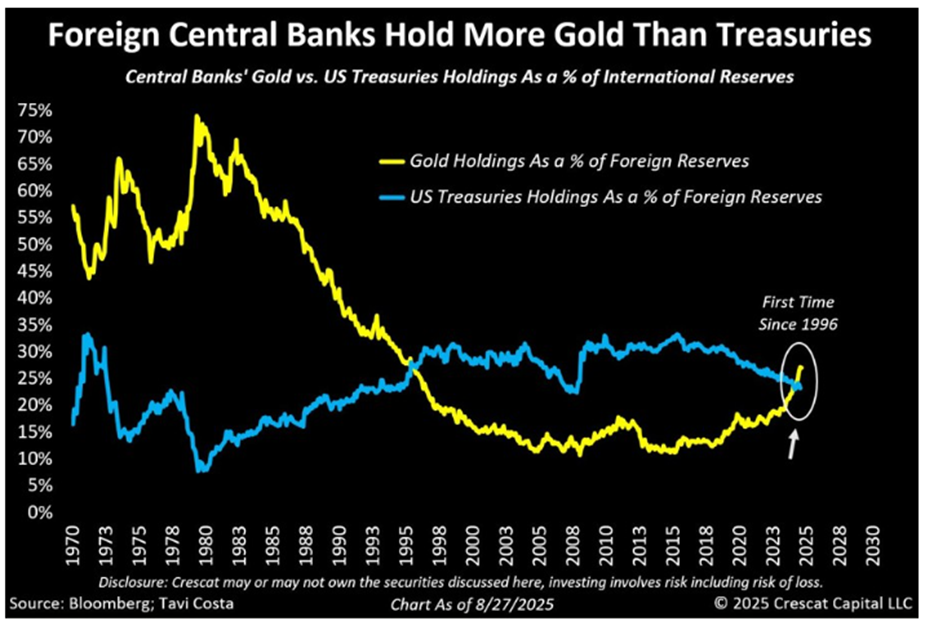
The U.S. dollar remains the world’s dominant reserve currency, representing roughly 57% of global reserves. While no fiat currency meaningfully challenges its position, its share has declined from approximately 70% over the past 25 years. At the same time, gold has grown as a share of foreign reserves, reflecting central banks’ desire for neutral reserve assets amid rising geopolitical and policy uncertainty. Since the U.S. formally ended dollar convertibility into gold in 1971, the global monetary system has relied entirely on fiat confidence - confidence that can ebb and flow.
Unlike gold, bitcoin is a digitally native monetary asset with a fixed issuance schedule and a short but growing institutional track record. Its long-term value proposition rests entirely on adoption. If adoption accelerates across institutional portfolios, sovereign wealth funds, or central banks, price appreciation could be significant. If adoption stalls, bitcoin returns will decline. Capital market forecasts vary widely- from five figures to several million per coin- highlighting both the uncertainty and the asymmetric return potential.
How Should Advisors Think About Allocation?
For investors concerned about long-term fiscal imbalances, inflation risk, or gradual erosion of U.S. dollar dominance, a modest allocation to alternative monetary assets may be appropriate.
Key considerations:
These are monetary hedges, not productive assets. Gold and bitcoin do not generate cash flow or contribute to value creation in the real economy. Long-term wealth creation still depends primarily on ownership of productive assets financed by equity ownership or debt.
Diversification benefits exist - but differ. Gold has historically behaved as a safe haven asset. Bitcoin has traded more like a speculative asset. Their correlation to each other has been low but volatile (~0.1), and correlations to stocks and bonds have been modest (<0.3), though bitcoin exhibits materially higher volatility.
Size positions modestly. Allocations under 5% are most likely to improve risk-adjusted outcomes without meaningfully impairing portfolio stability. A disciplined rebalancing process allows investors to harvest volatility while managing downside risk. Given the uncertainty around which asset may outperform over the next decade, a balanced allocation between gold and bitcoin can reduce concentration risk. Another reasonable approach is to use inverse-volatility weighting, which would increase gold’s relative allocation.
Disclosure: This article is for informational purposes only and does not constitute personalized investment advice. All investments involve risk, including the possible loss of principal. Past performance is not indicative of future results. Gold and digital assets, including bitcoin, are subject to significant price volatility and regulatory uncertainty. Digital assets are speculative and may experience substantial declines in value. Asset allocation and diversification strategies do not guarantee a profit or protect against loss. Investors should consult their financial advisor before making investment decisions.
Author: EverSource Investments Team