

Macro Update: Geopolitical Developments and the AI Revolution’s Impact on Capital Markets
Today’s investment environment is being shaped by two powerful forces: a rapidly evolving geopolitical landscape and an accelerating wave of technological disruption driven by artificial intelligence.
A central pillar of our investment philosophy is humility. The future is inherently uncertain, and no one can predict outcomes with precision. Rather than attempting to forecast events, we focus on making rational investment decisions grounded in how value is created in the real economy.
Geopolitics and Energy Markets
The geopolitical environment has shifted meaningfully in the first quarter of 2026. President Trump has signaled a focus on solidifying his foreign policy legacy by weakening adversarial regimes through targeted military actions rather than prolonged nation-building campaigns.
Influenced by Secretary of State Marco Rubio, a doctrine informally referred to as the “Donroe Doctrine” has emerged. This approach is characterized as extending the administration’s “America First” philosophy toward strategic dominance in the Western Hemisphere, with an emphasis on trade security and combating narco-terrorism.
Recent actions have included the removal of leadership structures in Venezuela and Iran, with policymakers’ attention potentially turning towards Cuba next.
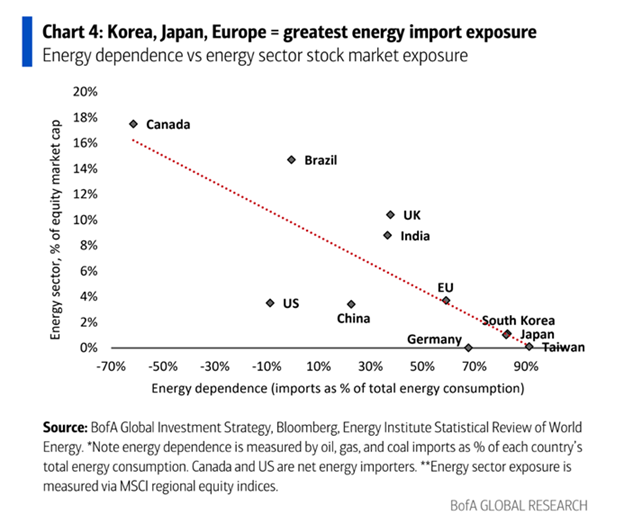
Following the Iran strike, the markets’ immediate transmission channel has been energy markets. 20 million barrels of crude oil and products flow through the Strait of Hormuz daily (approximately; estimates range from ~20–25% of global petroleum liquids consumption). Iran’s threats and ability to close Hormuz have contributed to increased volatility in oil prices. In turn, market participants and policymakers, including the Federal Open Market Committee, may take a more cautious approach to policy decisions, including previously anticipated rate cuts.
However, the United States today is structurally better positioned to absorb energy disruptions than in prior decades. Increased domestic production and lower economy-wide oil intensity mean that energy shocks may have a more muted effect on U.S. growth and inflation than they historically did.
The same cannot be said for many energy-importing economies. Over 80% of oil flowing through Hormuz is destined for Asian markets. China, India, and Japan remain more exposed to rising energy prices, as higher oil and gas costs can pass more directly into consumer prices and industrial activity.
A prolonged energy shock could therefore widen the economic gap between energy self-sufficient economies and energy importers, while oil exporters, including Russia, could benefit from stronger energy prices and improved terms of trade.
The AI Infrastructure Supercycle
While geopolitical headlines have dominated recent news cycles, the AI innovation and infrastructure buildout remains the most powerful structural driver of capital markets. Over the past year, we have seen multiple step changes in large language model development and AI capabilities. These advances may contribute to a period of accelerating creative destruction and new opportunities within the information technology sector.
Investment in AI infrastructure alone has been estimated to contribute approximately 2.5% to U.S. GDP growth in 2026. This wave of investment spans data centers and compute infrastructure, semiconductor and networking capacity, cloud platforms and AI development tools, and enterprise software transformation.
Information technology is the largest sector in both public and private equity markets, accounting for over 30% of market value, and is expected to be significantly impacted by AI developments. The effects of this transition will be felt across portfolios, and the range of potential outcomes is widening. The ripple effects of this technological transition are also appearing in direct lending as business development companies (BDCs) and interval funds have experienced rising headline risk and investor redemptions over the past quarter despite healthy credit quality.
Investment Implications
The current environment underscores several broader themes shaping our investment approach:
Geopolitical volatility may remain elevated for a period, particularly in energy markets.
The U.S. economy appears relatively well positioned compared to many global peers due to energy independence and stronger structural growth drivers.
Artificial intelligence represents a transformational economic force, likely to drive both opportunity and disruption across the technology sector first as this innovation filters into the broader economy.
In periods of rapid change, the discipline of focusing on long-term value creation rather than short-term predictions becomes even more important. Our role as stewards of capital is not to forecast every geopolitical event or technological breakthrough, but to position portfolios so they can participate in long-term economic growth while remaining resilient across a range of outcomes.
Disclosure:
This material is for informational purposes only and does not constitute investment advice or a recommendation to buy or sell any security. Forward-looking statements are based on current assumptions and are subject to risks and uncertainties. Actual results may differ materially. All investments involve risk, including loss of principal.
Author: EverSource Investments Team